Do You Need to Know How to Swim for Discover Scuba Diving?
Understand what water confidence you need before your first scuba diving experience.
Do You Need to Know How to Swim for Discover Scuba Diving?
Understand what water confidence you need before your first scuba diving experience.
Home » Do You Need to Know How to Swim for Discover Scuba Diving?
Do You Need to Know How to Swim for Discover Scuba Diving? 🤿
One of the most common questions before booking a first underwater experience is simple: do you need to know how to swim for Discover Scuba Diving? 🌊 The short answer is that you do not need to be a strong swimmer, but you should feel reasonably comfortable in the water.
A Discover Scuba Diving experience is not the same as a full certification course 📘. It is designed as a supervised introduction to scuba diving, where a dive professional explains the basics, helps you use the equipment and adapts the experience to your comfort, confidence and beginner level.
However, scuba diving should not start from panic, fear or complete insecurity in the water ⚠️. If someone cannot swim at all, feels blocked when they cannot stand, or becomes very anxious in the sea, it is important to mention this before booking so the local partner centre can assess whether the activity is suitable.
For a try dive or Discover Scuba Diving activity, you do not need to swim long distances or have perfect technique 🏊♂️. What matters more is having basic water confidence, being able to stay calm, listen to instructions and communicate if something feels uncomfortable.
At Family Elite Divers, we work as a booking and intermediary service, connecting travellers with certified local partner dive centres 🤝. The activity itself is carried out by the corresponding local partner centre, which confirms whether the experience is appropriate based on age, water confidence, sea conditions and safety criteria.
If you are still learning what this type of experience includes, you can read our guide to Discover Scuba Diving, where we explain how it works, what is included and what to expect before going underwater 🐠.
What Water Confidence Do You Actually Need? 🌊
For a first scuba diving experience, you do not need to swim fast, train in a pool or have a perfect swimming style 🏊. The most important thing is that you can stay calm enough in the water to follow simple instructions from the instructor.
As a general reference, it helps if you can do several of these things 👇:
- ✔ Enter the water without panic.
- ✔ Stay calm at the surface with the help of the equipment.
- ✔ Move your legs gently with fins.
- ✔ Breathe through your mouth without feeling overwhelmed.
- ✔ Listen to and follow simple instructions.
- ✔ Signal if you feel uncomfortable.
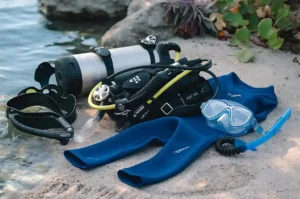
The scuba equipment helps a lot 🤿. The buoyancy jacket supports you at the surface, the fins make movement easier and the dive professional stays close during the experience. But the equipment does not replace basic comfort in the water. That is why being honest about your level before booking is always the safest option.
Common Situations: Can I Try Scuba Diving If I Am Not a Strong Swimmer? ✅
Not everyone who says “I cannot swim well” means the same thing 🌊. Some people simply have poor swimming technique but feel relaxed in the sea. Others can float, but get nervous. And some people feel intense fear as soon as they cannot touch the bottom.
That is why the real question is not only whether you can swim, but how you feel in the water 🤿. The key is whether you can stay calm, communicate and follow instructions during a supervised beginner experience.
1. I am not a strong swimmer, but I feel comfortable in the water
In this case, a Discover Scuba Diving experience may be possible ✅, as long as the local partner centre considers it appropriate. You do not need to swim long distances, because the activity is supervised, progressive and designed for beginners. The important part is to stay calm, breathe slowly and follow the instructions.
2. I can float, but the sea makes me nervous
This is very common 🌊. Many people feel nervous before their first scuba dive, even if they can swim. In these cases, it helps to choose a well-organized beginner experience with a clear briefing, calm pace and suitable conditions.
If you are preparing for your first time underwater, you may find our guide to what to expect on your first scuba dive useful, especially if you want to understand the sensations, breathing, depth and safety procedures before booking 🐠.
3. I am afraid when I cannot touch the bottom
If you feel blocked when you cannot stand, it is important to say this from the beginning ⚠️. Some beginner experiences may start in calm, shallow areas, but not every sea condition or dive site is suitable for someone with strong fear of deep water.
4. I cannot swim at all and I am scared of the water
In this case, it may not be the right moment to try scuba diving in the ocean ❌. It may be better to start with basic swimming lessons, pool confidence or a simpler water activity before booking a scuba diving experience.
5. I want to book for children or family members
For families, the most important thing is not to force the experience 👨👩👧👦. Some children and teenagers adapt very well, while others need more time. The final decision should consider age, maturity, water confidence, sea conditions and the judgement of the local partner centre.
If the goal is a calm first dive in the Canary Islands, you can also explore our diving in Tenerife page, where we group different beginner-friendly options, local areas and useful information before booking 🤿.
Discover Scuba Diving vs Open Water Diver Course 📘
This difference is important. A Discover Scuba Diving experience is a one-time activity designed to let beginners try scuba diving with professional supervision 🐠. It does not certify you as an independent diver, and it is meant for people who want a safe, simple introduction.
An Open Water Diver course, on the other hand, is a complete training program that leads to a diving certification. In that case, water skills matter more, because the goal is to become a more autonomous and confident diver.
That is why someone who is not a strong swimmer may still consider a simple beginner try dive if they feel comfortable in the water. But for a full certification course, they will need to meet the required water skills and show basic swimming and floating ability 🏊♂️.
If you are comparing whether to try scuba diving first or start training directly, you can read our guide to the Open Water Diver course and understand what a certification involves 📘.
Tips If You Want to Dive but You Are Not a Strong Swimmer 💡
If the idea of breathing underwater attracts you but you do not consider yourself a strong swimmer, do not rule it out automatically 🤿. Many beginners start with doubts and end up enjoying their first experience a lot. The key is choosing the right moment, destination and type of activity.
- ✔ Explain your real water level before booking.
- ✔ Do not exaggerate your confidence in the water.
- ✔ Choose a beginner experience, not an advanced dive.
- ✔ Ask whether the area is calm and suitable for beginners.
- ✔ Avoid booking if you have strong fear, panic or anxiety in the water.
- ✔ Do not force children, partners or relatives if they are not convinced.
- ✔ If you have medical doubts, ask a healthcare professional before diving.
It is also useful to understand practical details before booking 💶, such as how much the activity costs, what is included and how prices can change depending on the destination. For that, you can check our guide to diving prices in Tenerife, especially if you are comparing try dives, guided dives and courses.
FAQ: Swimming Ability and Discover Scuba Diving ❓
Can I try scuba diving if I cannot swim?
It depends on what you mean by “I cannot swim” 🌊. If you simply have poor technique but feel comfortable in the water, it may be possible. If you are afraid of the water or cannot stay calm at the surface, it is probably better to wait.
Do I have to swim during Discover Scuba Diving?
Not in the same way as a swimming lesson 🏊♂️. You usually move gently with fins, stay close to the dive professional and use scuba equipment. Still, you need to cooperate, stay calm and follow instructions.
Will the scuba jacket keep me floating?
The buoyancy jacket helps control flotation, especially at the surface 🤿, but it should not be seen as a complete replacement for water confidence. Safety also depends on your calmness, communication and the professional judgement of the dive centre.
Should I learn to swim before trying scuba diving?
If you are scared of the water or cannot stay relaxed at the surface, yes ✅. Learning basic swimming, breathing and floating skills will make the experience much more enjoyable.
Do I need to know how to swim for a scuba diving course?
Yes 📘. For a certification such as Open Water Diver, you normally need to demonstrate basic water skills, including swimming a set distance and floating for a certain amount of time.
Book a Beginner Experience That Fits Your Level 🐠
You do not need to be an expert swimmer to consider a Discover Scuba Diving experience, but you should be honest about your comfort level in the water 🌊. A good first dive should feel calm, progressive and adapted to you.
At Family Elite Divers, we help travellers find and book scuba diving experiences with certified local partner dive centres 🤝, so you can choose an option that fits your level, destination and expectations.
I’m Esteban, a diver and the person behind Family Elite Divers.
Tell me your skill level, your dates, and where you’d like to dive, and I’ll help you choose the experience that best suits you.
Do you have any questions before booking? Write to me, and I’ll give you personalized guidance.