
Sinus barotrauma and scuba diving: symptoms, risks and when you should not dive
Pressure changes matter: if you cannot equalise comfortably, stopping early is the safe choice.
Sinus barotrauma and scuba diving: symptoms, risks and when you should not dive
Pressure changes matter: if you cannot equalise comfortably, stopping early is the safe choice.
Home » Sinus Barotrauma and Scuba Diving: Symptoms, Risks and When Not to Dive
Sinus barotrauma in scuba diving can happen when the air spaces in your sinuses cannot equalise properly during descent or ascent. 🤿 It may feel like sharp facial pressure, pain around the forehead or cheeks, discomfort behind the eyes, upper tooth pain or even a nosebleed after the dive.
Quick answer: you should not scuba dive if you have nasal congestion, sinus pressure, sinusitis, thick mucus, facial pain or trouble equalising. Trying to push through the descent can lead to pain, barotrauma or an unsafe dive. If symptoms happen during or after a dive, stop diving and seek medical advice, ideally from an ENT doctor or a physician familiar with diving medicine.
This article is not a medical diagnosis and does not replace professional advice. 🩺 It is here to help you recognise warning signs and make safer decisions before Discover Scuba Diving, a course or a guided dive. When health is involved, the best dive is the one you can do while breathing and equalising comfortably.
🤧 What is sinus barotrauma in scuba diving?
Your sinuses are air-filled spaces that need to equalise pressure as depth changes. 🌊 If the passages are blocked by a cold, allergies, sinusitis, inflammation or mucus, air may not move freely. That pressure imbalance can irritate or injure the tissues inside the sinus cavities.
DAN World describes sinus barotrauma as a condition that can cause sharp facial pain during descent or ascent, and sometimes blood from the nose after surfacing. You can check its medical resource on sinus barotrauma. 🧭
- It is not only an ear problem: it can affect the forehead, cheeks, nose or upper teeth.
- Congestion is a common risk factor: colds, allergies and sinus infections can make equalisation harder.
- It can happen on descent or ascent: depending on how trapped air moves.
- Forcing it is not the answer: pushing through pain can make things worse.
- Symptoms may continue after the dive: pain, pressure, blockage or a nosebleed can remain.
- Early action matters: if pain appears, stop descending and signal your instructor.
👂 Symptoms and warning signs
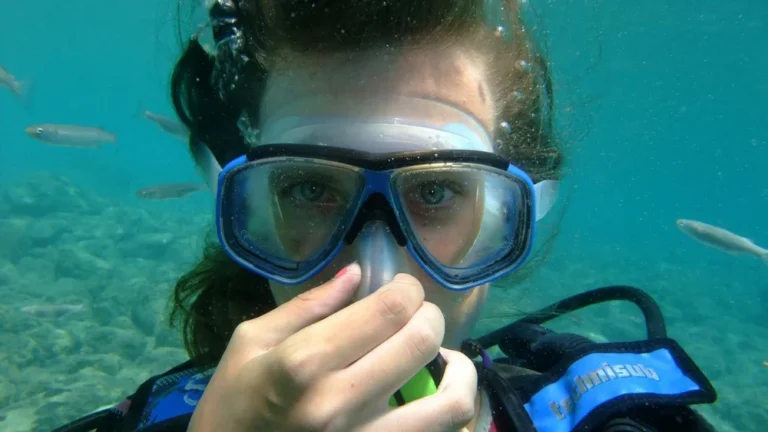
The most common sign is pressure that does not clear when you try to equalise. 🫧 It may feel like pain in the forehead, behind the eyes, in the cheeks or even in the upper teeth. Some divers also notice strong congestion or blood from the nose after the dive.
| Symptom | What it may suggest | What to do |
|---|---|---|
| Forehead or cheek pain | Sinuses may not be equalising properly. | Stop descending, go slightly shallower and signal. |
| Ear pain | Possible ear equalisation issue or ear barotrauma. | Do not force it; end the dive if it persists. |
| Nosebleed after diving | Possible irritation or pressure injury. | Do not continue diving; seek advice. |
| Dizziness or vertigo | Potential inner-ear or other serious issue. | Abort the dive safely and get assessed. |
| Strong congestion before diving | Higher chance of failed equalisation. | Postpone the dive. |
Why you should not force equalisation
If something is not clearing, the solution is not to blow harder or tolerate pain. ⚠️ The correct response is to stop, ascend slightly, try to equalise gently and signal your instructor. If it does not improve, the dive plan should change or the dive should be cancelled. DAN Europe also advises against continuing to descend with ear pain in its guide to ears and diving.
This connects directly with basic equalisation technique. 👂 If you want to review it calmly, read our guide on how to equalise your ears while scuba diving. But remember: if there is pain or a real blockage, you do not force it.
FED tip: if you have a cold, sinus pressure, strong allergies or facial pain, tell the dive centre before the activity. A serious centre would rather postpone a dive than put you in the water with a higher risk of barotrauma. Cancelling early is often the most professional decision.

✅ When not to dive and how to reduce the risk
Prevention starts before you put on the wetsuit. 🤿 If your nose feels blocked, you have sinus pressure or you recently had sinus pain after diving, do not wait until you are underwater to test whether you can equalise. Speak with the centre first and be honest about your symptoms.
You should not dive if…
- You have strong nasal congestion or active sinusitis.
- You feel pain in your forehead, cheeks, ears or upper teeth before entering the water.
- You cannot equalise gently on the surface.
- You recently had barotrauma and have not been cleared to dive.
- You need medication to breathe or equalise without medical advice.
- You had nosebleeding or strong pain after a previous dive.
If the issue started with a cold, read our guide on whether you can scuba dive with a cold. 🧭 For beginners, this is especially important because even the first few metres create enough pressure change to cause discomfort, including on a shallow Discover Scuba Dive.
Pre-dive checklist
- You can breathe normally through your nose without blockage.
- You have no facial pressure, sinus pain or ear pain.
- You feel well rested and have no fever or general illness.
- You can equalise gently, without blowing hard.
- You have told the instructor about any symptoms before entering the water.
- You are willing to stop if pain appears during descent.
If you have a history of sinusitis, nasal surgery, strong allergies or repeated equalisation problems, ask a specialist before diving. 🩺 You can also check our guide to the medical certificate for diving in Spain, especially if you are unsure before booking a course or experience.
❓ FAQ about sinus barotrauma and diving
What does sinus barotrauma feel like?
It can feel like sharp pain or strong pressure in the forehead, cheeks, nose or upper teeth. It may happen during descent, ascent or after surfacing. 🤧
Is sinus barotrauma the same as ear pain?
Not exactly. Ear pain usually involves the middle ear, while sinus barotrauma affects the sinus cavities. Both can be linked to congestion or failed equalisation. 👂
Can I keep descending if it only hurts a little?
No. If pain appears, you should stop descending, signal your instructor and ascend slightly. If it does not clear, the dive should be changed or cancelled. ✅
Can a nosebleed happen after scuba diving?
Yes, it can happen in some cases of sinus barotrauma. Do not ignore it: avoid further diving and seek medical advice. 🩺
Do decongestants prevent sinus barotrauma?
They are not a guarantee. Their effect can vary or wear off. If you need medication to dive, speak with a doctor first. 💊
When can I dive again after sinus barotrauma?
When symptoms are fully gone and, if there was strong pain, bleeding, vertigo or injury, when a medical professional clears you to return to diving. 🌊
In short: sinus barotrauma is not something you beat by tolerating pain. You prevent it by diving in good health, equalising gently and stopping early when something feels wrong. If you are unsure before booking, you can contact Family Elite Divers and we will help you choose the safest option with selected local partner centres.
I’m Esteban, a diver and the person behind Family Elite Divers.
Tell me your skill level, your dates, and where you’d like to dive, and I’ll help you choose the experience that best suits you.
Do you have any questions before booking? Write to me, and I’ll give you personalized guidance.